
The Moment It Began
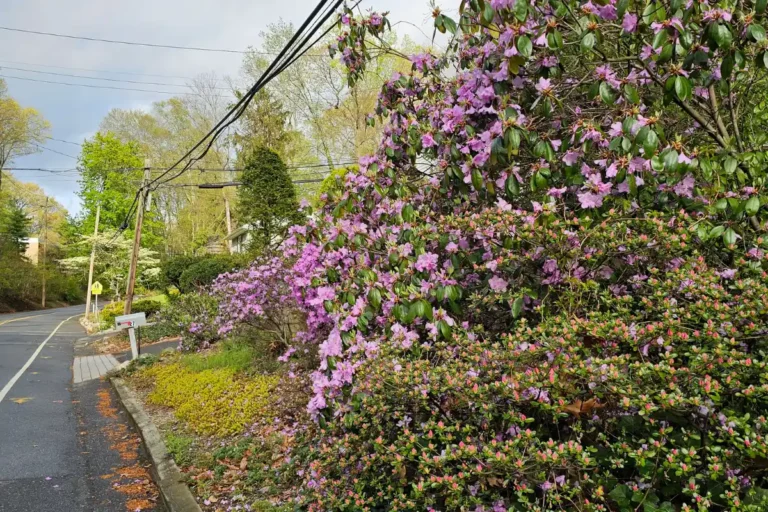
It began with me taking a walk, and ended with me wondering whether I lived in a bee-friendly neighborhood.
Last summer I was out on a fresh-air power walk through Glen Head. If you don’t remember, it was intensely hot and dry. Water restrictions were in place, and lawns everywhere were showing signs of stress.
As I walked—waggling my hips and rolling from heel to toe—this Queen Bee noticed something surprising: there were hardly any flowers around.
Now, if you’ve been to Glen Head, you might want to argue with me.
It’s a beautiful community—lovely landscaped properties, rolling hills, mature trees. Curb appeal is not up for debate.
But the appeal to a weary, hungry bee? That’s another story.
Down on Kissam Lane, I did notice flowers—but they weren’t in anyone’s garden. Weeds, particularly knotweed, were blooming along the fence line by the North Shore Golf Course.
And yes, there were hydrangeas. Almost every home has them. But most are mophead varieties—and I hate to tell you—those big, beautiful blooms are essentially barren deserts for bees. No nectar to be found there.
House after beautiful house. Neat lawns. Well-tended shrubs and trees.
But almost nothing for honeybees to eat.
It made me wonder… is Glen Head a bee-friendly neighborhood?
What Bees Actually Need
Honeybees may be small, but they are incredibly industrious. They pollinate a significant portion of our food—from apples to zucchinis—and right here in Glen Head, they support backyard gardens and produce some of the best local honey around.
They don’t ask for much—but they do need reliable nectar sources throughout the season. In a bee-friendly neighborhood, a honey bee should be able to buzz from yard to yard and find something, somewhere.
That’s part of what defines a truly bee-friendly neighborhood—continuous blooms from early spring through fall.
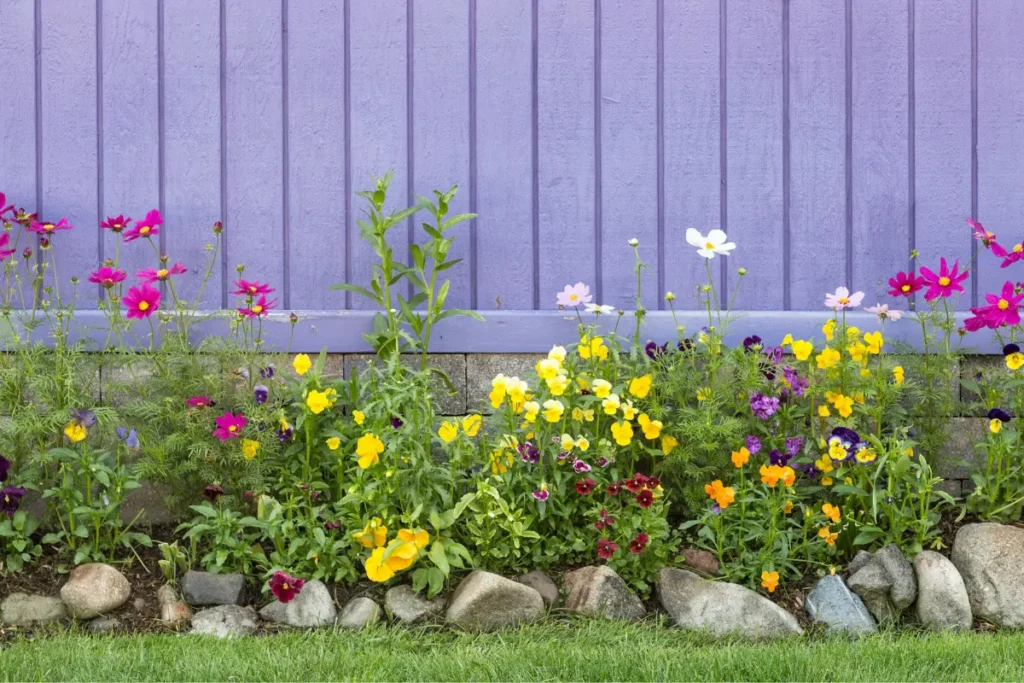
On the North Shore, that season is relatively short. Bees typically forage from April through September, so ideally, something should be blooming on every block throughout that time.
Nectar is found in many—but not all—flowers. Bees are especially drawn to simple, open blooms in white, yellow, purple, and blue. Flowers with flat centers—like lavender, cosmos, and sunflowers—provide easy landing zones and accessible nectar.
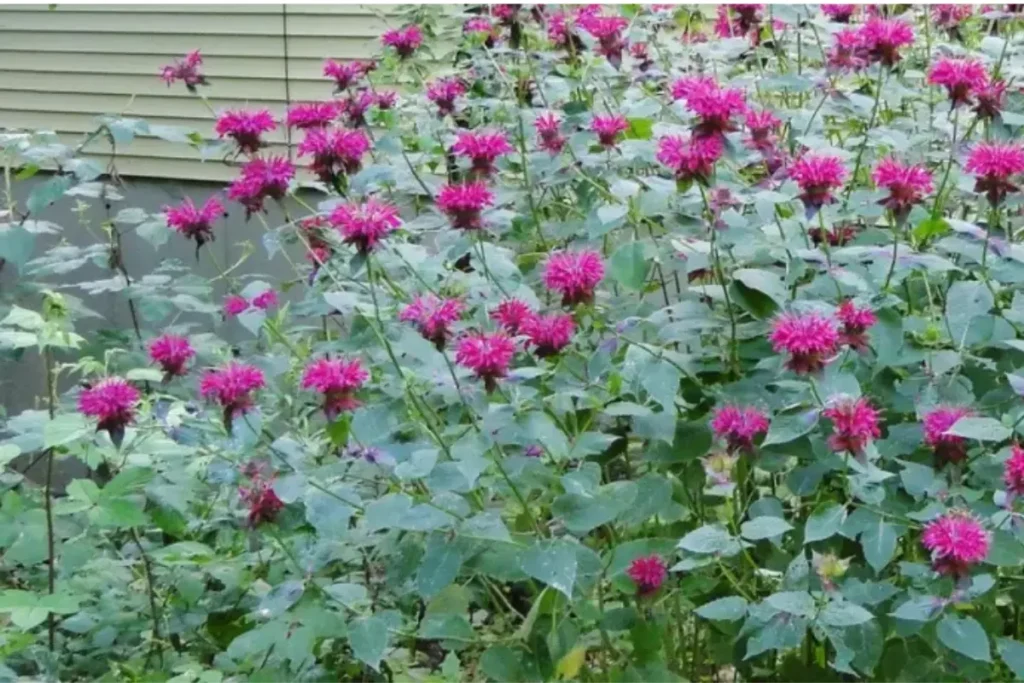
Bees also need:
- Clean water (from soil, leaves, or shallow sources like bird baths)
- Chemical-free environments (pesticides can damage their nervous systems and navigation)
And if you’re worried about attracting too many bees—don’t be. Bees are focused and purposeful. They stop briefly, then return to their hive. They know exactly where they’re going.
The “Green But Empty” Landscape
Communities across the country are beginning to rethink landscaping through programs like Bee City USA and Pollinator Pathways, encouraging more intentional planting.
But in many suburban areas, including the North Shore, a different pattern still dominates. And it doesn’t help to create a bee-friendly neighborhood.
We love structure.
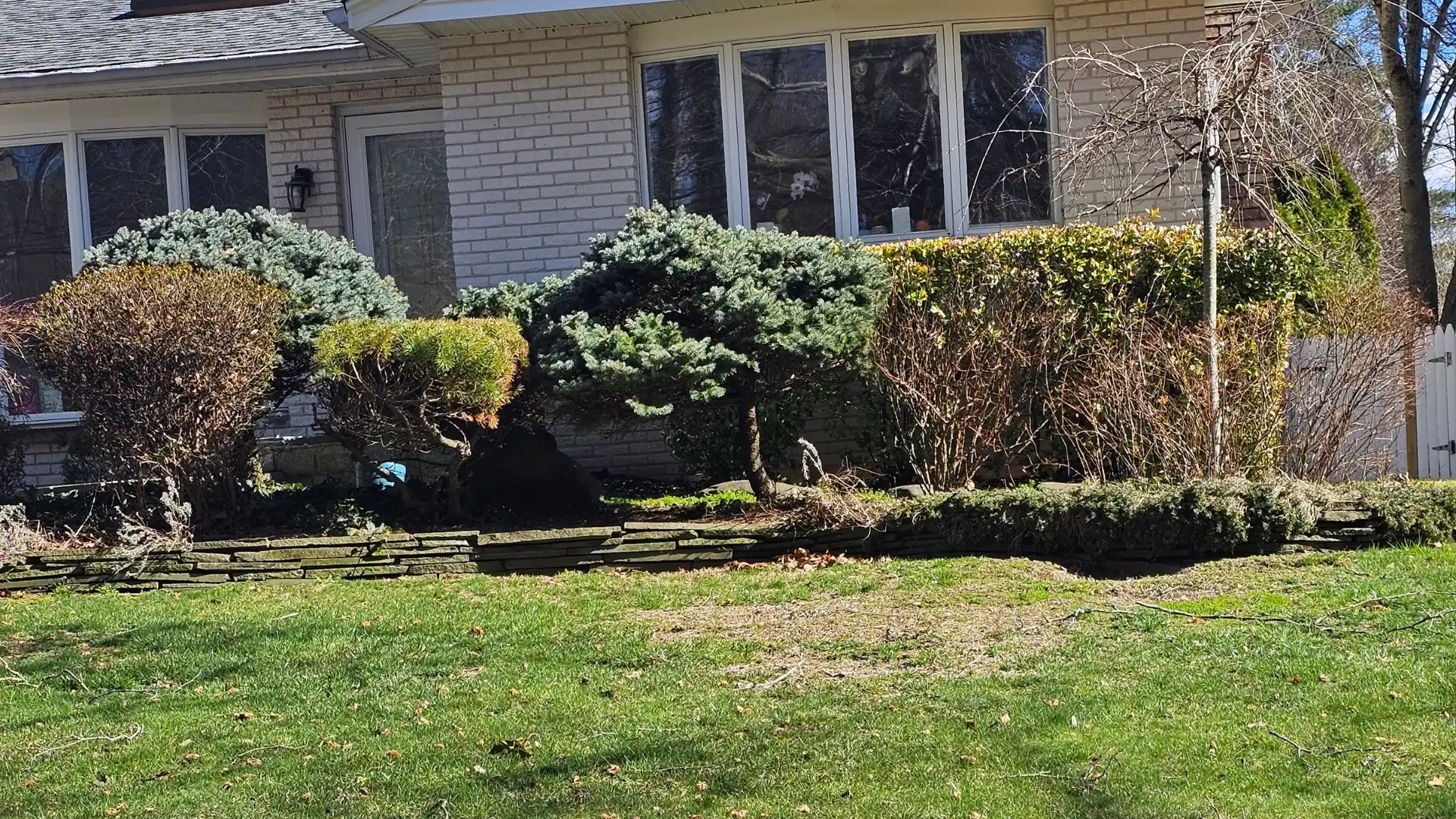
Boxwood hedges.
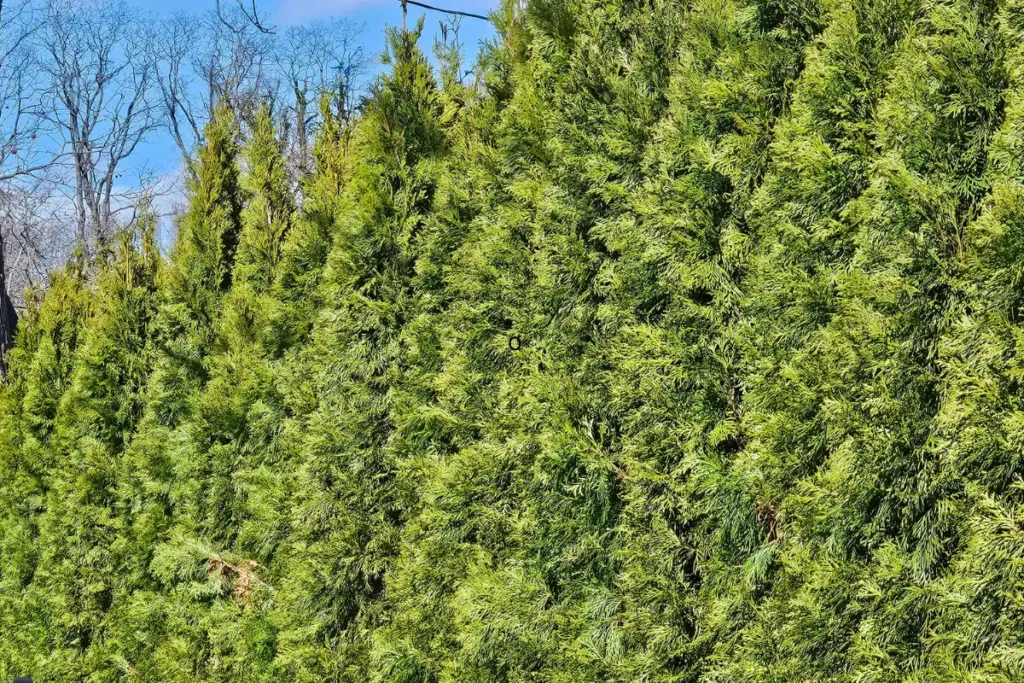
Arborvitae screens.
Juniper foundations.
These “living fences” provide privacy and year-round greenery—but very little for bees.
In summer, we add color with impatiens, begonias, and hydrangeas. In fall, mums and pumpkins decorate our doorsteps.
The result is beautiful. Photogenic. Carefully curated.
But beautiful landscaping isn’t always the same as bee-friendly landscaping.
A yard can be full of green—and still be almost empty.
The Backyard Bees Landscape Scorecard
We all have different skill levels, and I hear it all the time—“I don’t have time to garden.” I have some counterarguments for another day, but for now, I have a simple request:
Take a walk around your yard and really notice what’s growing.
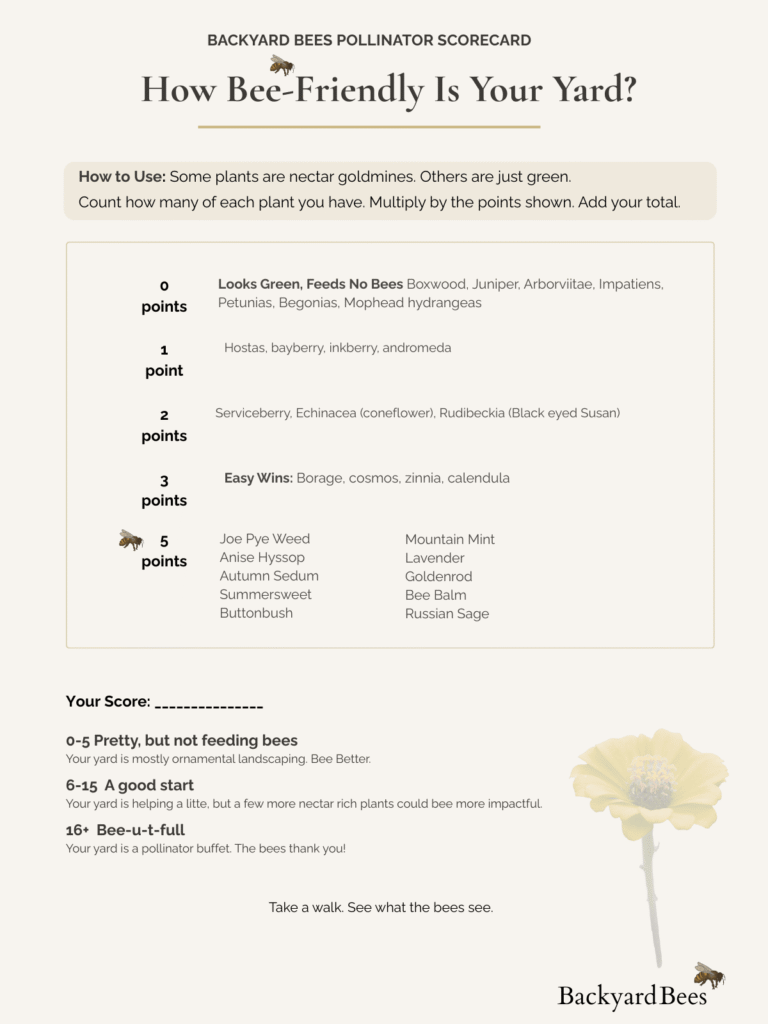
I created the Backyard Bees Landscape Scorecard as a tool to help you see your space from a beekeeper’s perspective. Do you live in a bee-friendly neighborhood?
Each plant is assigned a point value based on how well it supports foraging honeybees—especially during critical times like early spring and late summer.
Count how many of each plant you have. Multiply by the points shown. Add your total.
If you don’t know your plants, I like using an app called PlantNet. It’s free, easy, and surprisingly accurate—just snap a photo and it identifies the plant for you.
You might discover that your yard is a nectar desert in August.
Or that your hydrangeas aren’t quite what you thought.
Or—you might be pleasantly surprised.
This isn’t an exhaustive plant list. It’s a starting point—focused on plants that grow well on the North Shore and are easy to find.
A Fresh Start This Season
You know I love to bee outside—and I walk year-round.
Starting this spring, I’ll be sharing observations from walks through neighborhoods across the North Shore—Glen Head, Sea Cliff, Glen Cove, and beyond—using the Backyard Bees Landscape Scorecard as a guide.
If I had scored Glen Head last summer, it would have landed on the low end of the bee-friendly neighborhood scale.
But landscapes change. Gardens grow. And every season is a chance to do a little better.
Curious what your neighborhood looks like from a bee’s perspective?
You don’t have to wait for me.
Take a walk around your own block.
Look for what’s blooming.
Notice what isn’t.
Plant a few flowers. The bees will notice.
Adding even one nectar-rich plant can help—I’ve shared a few easy favorites in my guide to bee-friendly seeds.
And yes… I’ll bee watching. 🐝
Next up:
A Walk With A Beekeeper: Early Spring in Glen Head (March 2026)
A Walk With A Beekeeper: Early Spring in Sea Cliff (April 2026)